Ecommerce Integrations
Best for SMBs and lightweight e-commerce solutions looking for a cost-effective, user-friendly solution.
Seamless integrations from strategy to implementation
Ecommerce integrations are essential for automating the transfer of data to avoid data entry errors and double keying and a huge side effect of this is operational efficiency.
Streamlining operations can be challenging due to complex workflows, incompatible systems, and conditional rules. A well-thought-out integration strategy, system mapping, and best practice planning are critical before execution.
It’s not just a case of integrating point A to point B – you need to design a solution that enables you to add more tech into the same integration blueprint, future-proofing your architecture.
Ecommerce integration solutions
We specialise in delivering seamless, end-to-end integrations using three custom methods

One-to-one Integrations
Direct connections between two systems. Best for simple, direct connections (e.g. linking an ecom store to a single ESP)

Middleware-Based Integrations
Utilise iPaaS products like Patchworks, Alumio, and Celigo to connect multiple systems efficiently. Ideal for businesses managing multiple system connections (e.g. syncing PIM, ERP, Ecom and WMS)

Custom Middleware Solutions
Bespoke middleware development for businesses needing an open-source or owned solution. Ideal for unique workflows that off-the-shelf middleware cannot support or for those seeking full control.

Ecommerce Integration Services
Get in touch
End to End Implementation
Comprehensive solutions from design to setup to deployment.

Complex / Conditional Integration rules
Advanced logic and rules to handle intricate workflows and custom business logic

Custom/iPaaS implementation and support
Expertly crafted integrations with ongoing support for custom and iPaaS platforms.

Integration Support
Dedicated assistance to maintain, troubleshoot, and optimise your integrations for peak performance.
Platforms we support

Patchworks

Alumio

Celigo



Why choose us
Dev Team is not just an integrator but a strategic partner. Many businesses struggle with integration choices (direct vs. middleware, custom vs. iPaaS), and we step in to not only deliver the integration, but to share our expertise to guide our clients toward the best solutions.
For over 25 years, Dev Team has delivered bespoke solutions that drive results. Our team of 50+ professionals bring industry best practices, top-level advisory and expertise, ensuring every ecommerce integration project is a success.
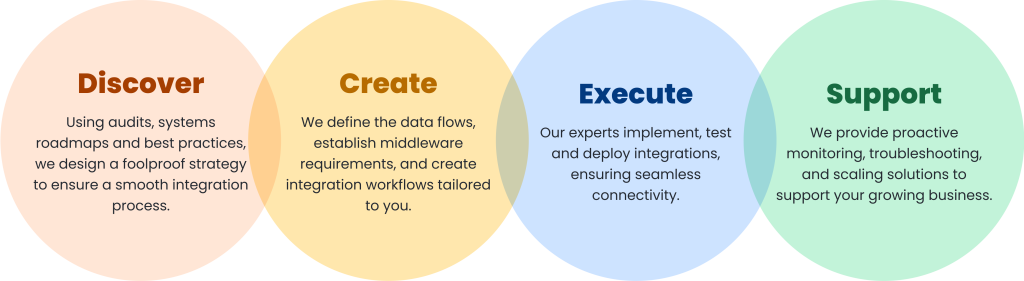
How we work with you

What Patchworks says about us

Seeing their team grow and collaborate so effectively with us has been incredible, and we’re excited to see this partnership evolve further in 2025!



Frequently asked questions
What is ecommerce integration?
Ecommerce integration is the seamless transfer and synchronisation of data between different business systems, eliminating the need for manual intervention or double data entry. When using an iPaaS (Integration Platform as a Service) as middleware, it automates data flow between platforms.
For example, in an ecommerce setup:
- A warehouse platform updates stock levels in the ecommerce platform, ensuring only available items are sold.
- When a customer makes a purchase, data flows through the warehouse platform and/or ERP (if present), adjusting stock levels, updating accounting systems, and ensuring real-time accuracy.
Why is ecommerce integration important?
Effective ecommerce integration makes scaling your business seamless, preventing inefficiencies and future roadblocks. Key benefits include:
- Flexibility – Choose the best tech stack instead of being locked into a single platform provider.
- Automation – Eliminates manual data entry across systems, reducing errors and saving time.
- Inventory Accuracy – Prevents underselling or overselling by ensuring real-time stock updates.
Which systems can be integrated with an ecommerce platform?
Virtually any system can be integrated. The most common integrations via iPaaS include:
- WMS (Warehouse Management Systems)
- 3PL (Third-Party Logistics Providers)
- ERP (Enterprise Resource Planning)
- Returns Platforms
- Marketplaces (e.g., Amazon, eBay, Zalando)
How do I integrate my ecommerce store with an ERP system?
ERP integration requires careful planning and execution. At Dev Team, we follow a structured approach:
- Discovery – We audit your business, create system roadmaps, and define the integration strategy.
- Design – We map out data flows, determine middleware requirements, and create integration workflows.
- Execution – Our experts build, implement, and test the integration to ensure seamless connectivity.

Get your project started
Prefer direct contact?

Phone
(02) 7004 4847
Prefer direct contact?
Phone
(02) 7004 4847
Prefer direct contact?
Phone
(02) 7004 4847


